Showing posts with label Hardware. Show all posts

Thursday, 26 January 2012

Why its important to prototype

Some early prototypes are purely aesthetic. I made one for my final year project
When we have ideas down on paper, they are in essence theoretical. But theories cant be proven or debunked without them being tested out in practice. No amount of theory can ever say for certain if it will work in practice because no matter how hard you try, it is impossible to consider all possible factors.

External factors can range from a large number of things. In architecture, they are more likely to be based on environmental factors, such as ground movements, temperature wind and rain. Products are going to be more focused on external factors in the form of a human and how they interact with it (people are probably harder to predict than the weather).

Secondly, when designing products or electronic circuits, there can be a lot of guess work involved; certain parameters just cant be fully defined until you know how the whole system is going to react. It is there for imperative to test the system.

In fact, if anything man-made breaks or goes wrong it is always because the factor that caused it was not foreseen by the designer, or they failed to act upon it. If you try to open a beer can and the ring pull breaks off, its because that certain manufacturing defect was not taken into account. If you stand on a chair to fit a lightbulb and you put your leg through the seat, its because it was not designed to take that much force in such an isolated area. Or if your computer freezes while your working, its because the particular sequence of executed code that caused the error was not properly written inorder to avoid it.

But thats OK. Nothing can be made indestructible or made to suit everyone in every situation. Sure, companies try to do it, but even the mighty Apple are not immune to major product faults. Every product developer reaches the point where they have to stop developing and release it into the world, onto shelves and open to the scrutiny of the increasingly fickle consumer.

In electronics, some blue foam and Pritt Stick can
make the best tests
In many ways thats what makes the difference between a good product and a bad one; how much time, money and effort they put into development before its released. The majority of this time and money will be spent on 10's, maybe even hundreds of prototypes; each made, tested, evaluated and then superseded by the next, and then the next, and the next...

Even after a product is released, changes might be made in the design when products keep getting returned with common faults. Thats why its often useful for companies to have a warranty on their products, so that if there is a recurring fault, it gets logged and the product returned for the problem to be diagnosed and fixed.

The thing is, if you design something you can never fully understand it until its real. There are so many factors that cant be foreseen, so many things that can go wrong. Whether it's a good design or bad design, its not even a full design unless its been made.

Monday, 23 January 2012

Technology and the Development of Teaching

As Seymour Papert inquired in 'The Children's Machine' (1993), if using a time machine and you were to bring a group of teachers and a group of surgeons from 100 years past into present time, how would they fair at their craft?
The surgeons would probably have a hard time adapting to the new tools and techniques used in hospital theatres today, but despite the new technologies in today's classrooms, the teachers would probably find it easier to adapt and teach nearly as effectively as teachers do now (apart from getting overwhelmed with the increase in unruly, undisciplined, knife-wielding kids).

If this were they case, Papert asks, then why? Why has medicine developed far more than education? Is it because the ways we used a century ago were the best ways to teach? Is it because the pressure to improve surgical methods has been greater than for education? Or maybe the success of new medical procedures are far more quantitative and obvious than a new teaching technique.

Possibly for medicine in many ways, the tools have dictated the techniques. New technologies have directly influenced how a medical professional works on their patients; from making diagnoses easier to making incitions smaller. In schools however, the influx of technology has only recently been making a direct effect on teaching methods.

This, I expect, is due mostly to how the technology is packaged. Desktop computers have been in most classrooms for nearly a decade, but its only until the screens could be projected onto whiteboards did the power really be injected into every lesson. Now with the new wave of tablets, the technology is not hindering the learning experience but complementing it.

The development of technology:

The fast development of technology is most certainly a double edged sword. In one sense it is greatly enabling;  the stuff only realised by science fiction authors a short time ago is entering our homes (and classrooms), providing us with media and services in ever more convenient and fast ways. But on the other hand, the speed of progress makes everything around it seem dated as quickly as version 2.0 comes out.

Look at any physics textbook thats 5 years old, and apart from the omission of Pluto you will most likely see very little difference between that and a book published yesterday. Do the same with a book on ICT and you would have a hard time following it. Despite a PC now having very simliar tools to one 5 years ago, the volatility of software has caused those to be changed and updated beyond recognition.

Therefore, learning resources associated with such technologies must be built so they utilise technology rather than rely on it. Rather, the learning resources must be backed up by a skill-set, methods rather than specific tools should be the backbone of this work.

Monday, 9 January 2012

Pinguino


Pin-goo-ee-no, Ping-wee-no, I'm not sure how to pronounce it. But this is a project that been developing since 2008, with the purpose of designing an Arduino that can be built on the cheap by anyone at home. It mostly supports Arduino code, and this is getting improved on. As for other hardware, for the next release they they are working on supporting Zigbee, OTG and CDC, which makes it a hell of a lot easier to plug things in and get them working. Also whats interesting is that they are working on getting Android support, so effectively turning this into an ADK board as well.

What caught my eye though is that the guy who developed it, Jean-Pierre Mandon, is a teacher at the robotic lab at the Aix en Provence School of Art in Southern France. Why an art school needs a robotics lab I'm not yet sure, but initially this project was meant as a tool for his students. This guy might be useful to talk to.

Ultimately, it looks like they are saying this board exists to build more features into the existing Arduino platform, while making it more widely compatible and cheaper to make. I think its worth giving this a look at, at least after the next version.

More info and an interesting interview at MAKE and the original site here.

Friday, 28 October 2011

Dirt-cheap tablet

Following on from the OLPC, the indian government has released a subsidised $35 tablet to distribute around their schools. Subsidised maybe, but not by much - $60 is its retail price, amazingly cheap for any touch screen tablet. Android OS, resistive 7" screen, Wifi, GPRS modem, 256GB ram, 2GB internal storage (expandable). Pretty good!


India is already a well known source of cheap app development, imagine what it will be like in 10-15 years time with kids growing up with this technology.

Monday, 24 October 2011

'Learning' Doesn't Necessarily Mean 'Teaching'...

Or not 'teaching' how you might perceive it.
Below is a short but interesting video that sums up part of what I'm talking about on this blog, and what I'm trying to achieve with my studies. It's where learning doesn't focus on being taught, but on creating things and achieving goals - the teaching is a biproduct.


Mike Masnick - Innovations in Education from SAY Media on Vimeo.

Its from an article on Techdirt that, while focusing on the use of Information Technology, also touches on how education can be fun, more productive and more effective. It also talks about how so much focus is given to class sizes, and how it's supposed to effect the amount of attention given by the teacher to each student. But when students are more immersed in the activities and given the opportunities to share knowledge and to help teach their peers, this becomes far less of a problem.

Now, while some of the article focuses on bringing Information Technology into classrooms (and it would, being part sponsored by Intel), I have to make it clear that I dont entirely agree with it. While my research is about 'teaching technology', I dont think pixilating everything from the paper to the pencil sharpener makes for better learning, necessarily.
I think I can speak for everyone (certainly my Mum) when I say that technology can often get in the way. When you plug in a printer and it doesn't work, or when files are lost, or the system freezes...etc. Granted its getting easier and errors occur less with every upgrade, but we are still a long way from a mouse and keyboard being more reliable as pen and paper. And even then, sometimes reality is a far better tool than a touch screen.

The success relies in getting a balance, and not (as Intel would like you to believe) about everything being automatically better if it runs on Bits and Bytes.

Wednesday, 19 October 2011

New Toy

I have a new toy.


IR remote helicopter! Totally worth the £20 it cost, even more so as I got it as a gift. Tonnes of fun, and the rest of the office hate love it! I'm sure I can make some sort of app for this so I could control it like an AR.Drone.

In the mean time, I've been developing cardboard containers to transport potato crisps to various desks...

Thursday, 13 October 2011

Technology Will Save Us


The other week I visited the London Design Show at theV&A. There I found a company who's aim is to teach the public how to do things that everyday we take for granted, called Technology Will Save Us. Practical skills like gardening, sewing, woodwork, or electronics; they teach them all in a shop on Brick Lane and now have started up classes in Budapest.

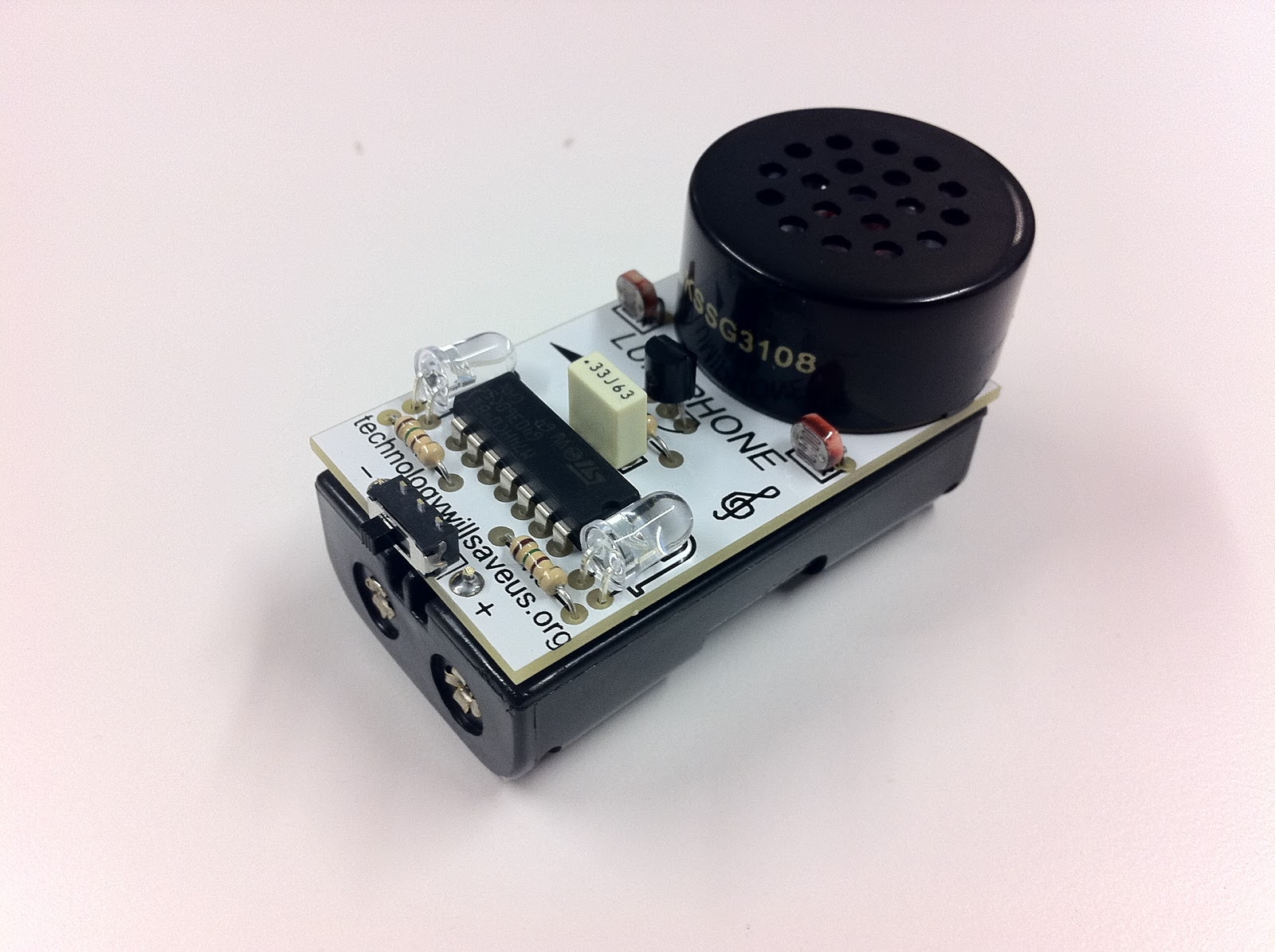
They also sell little kits, like this Lumiphone, which I bought of them for £10. It comes with all the parts, all you have to do is solder them together.

It works like a Theremin, those odd sounding instruments you hear in films like Forbidden Planet. There are two LED's shining onto light sensors; the one on the left controls the volume of the noise, the one on the right controls the pitch. All you do is vary how much you stick your fingers in between them and it makes funky noises.

What amazed me was how simple the circuit was. Apart from the 2 resistors to protect the LEDs, it only uses 6 types of components to make the noise: a capacitor, a transistor, a resistor, 2 LDR's, 2 inverters (the IC) and of course the loudspeaker.

It was easy to make and its fun to play with; a classroom-worthy project.

Check out a video of it working below.