Showing posts with label Learning. Show all posts

Wednesday, 27 June 2012

REC:all webinar


Yesterday I watched a web seminar on REC:all - 'Building a community of practice about lecture capture in EU universities'. I had previously not heard of the initiative, but from listening to the speakers and reading more into it, it seemed very interesting.

The speakers were Yacine Abboud from the University of Lorraine, Clive Young from University Collage London, Mathy Vanbuel from KHLIM, Silvia Moes from VU University of Amsterdam and was headed by Sally Reynolds, managing director of ATiT.

REC:all is a project that seeks to develop and better integrate digital lecture capturing technologies into higher education for the purpose of off-campus learning. As well looking at lecture recording and delivery, they are interested in implementing new technologies into remote learning environments, such as study trips and excursions.

One example of this was from Silvia Moes who provided a case study where students on a trip to Rome were told to form groups, each collecting evidence from around the city and depositing it on an open source mapping software. The map could be accessed by the other students who could learn from the data collected from the group.

Particular emphasis in the webinar was put on 'Flipping', a way of providing prerecorded audio or video lectures before a timetabled session so that more time can be spent in the session for the type practical, hands-on instruction that cant be effectively communicated with just a video. Pamala Kachka from Pearson eCollage gives a nice overview of Flipping here.

Another initiative that was mentioned was transLectures, which has been running since November 2011 and whose objective is to develop solutions that translate video lectures into many languages to reach wider audiences.  

Tuesday, 22 May 2012

Technology Will Save Us - Interview


Ever since I got my Lumiphone Kit, I have been really interested in the work of Technology Will Save Us, a small group of guys who set up communal workshops usually in empty shop spaces, aimed at members of the public who want to learn more about electronics and making things themselves.

The above video is an interview with Daniel Hirshmann, one of the Cofounders of the company, where he talks about the reasons for setting up the project as well as how well its doing.

He starts by talking about how he wanted to start a company that did not only make a profit, but also gave back to society with more than just more products that will later end up in a landfill. Their goal was to create some kits that encourage people to learn more about technology, learn to be more creative technology and learn to produce it, not only consume it.

He says with the increased complexity of technology, along with the recession, there is a growing public interest in becoming more hands-on and learning new skills that save money and help people become more self dependent.

So now they set up workshops that help teach people how to put the kits together, as well as creating a fun, inclusive, communal atmosphere. Whats interesting is how he talks about the huge cross-section of people that come to the workshops; he mentions that not once have there been no women in a workshop session, yet there has been sessions with no men.

He talks about how their work can influence larger corporate companies by showing them that there are ways of producing while also giving back to the community and engaging with your customers. TWSU are selling a product that a customer buys, but also gets taught new skills and knowledge that they can take away to help improve their lives.

He then touches on open source communities online and the vast resources available to anyone who wants to take on something like electronic prototyping, but makes a good point by saying that many people struggle to pick that up when it is a list of steps or lessons online, but find it easier when it is booked out as a fixed time and place where the learning takes place. That is where the workshops come in.

People Shouldn't Learn To Code

A debate has come about recently, spawned firstly from a tweet by the major of New York City, Mike Bloomberg, and then a response by a guy called Jeff Atwood. The original tweet is below:


Great, the guy wants to learn code, lets leave it at that. But Jeff Atwood thinks not. Jeff is a bit of a superstar in the coding community, and on his blog he posted a piece called Please Don't Learn to Code.

His points seem to mainly revolve around his dislike for inexperienced programmers being employed and messing it up for the rest of them.


True, its not good to dilute the skill level of a workforce by flooding the sector with unqualified workers, but that might be more a problem with employers not hiring the right staff. Or if it is about there being too many under-qualified coders, surely that will mean there will be an increase in perfectly good coders who will no doubt float to the top.  Jeff seems to be inferring that if more people learn to code casually, everyone will want to be a professional coder.

Some people in the comments of this article can see his point and attributes this to the Dunning-Kruger effect, whereby incompetent people have a tendency to overestimate the level of their skill, and fail to realise where they fall short. This could well be true, but I digress.

What Jeff only touches on however, is the move to push programming into the forefront of education, and making it as an important as Maths, English and Science, something that Papert would advocate. Jeff says this wrong, as well as 'learning to code for the sake of learning how to code'.

As the writer of this post points out, learning to code is does not mean seeking to become a professional programmer, but is about gaining a better understanding of the technology that we use, and by gaining a whole host of transferrable skills that are applicable to thinking and solving all sorts of problems and as a way of approaching learning itself.

So, while I highly doubt Mike Bloomberg is really ever going to learn how to code, the question is should he? Yes, I think he should. I think many of us could do with understanding more of the basics of what makes the things we hold in our hands, the displays we read off every day, work (and also not work).

esmoove puts it well:
Learning new skills opens up new perceptual avenues and cognitive spaces. I'm learning to sew right now, not because the world needs another tailor but because I want to be able to recognize quality in clothing and create pieces that I can't find. Novice coders feel the same way about their digital goods and should be encouraged to continue. Learn to program.

Tuesday, 8 May 2012

Meeting with Steve Gill, Cardiff Met


Last Friday, the 4th May, I visited Professor Steve Gill at Cardiff Metropolitan University's Product Design Research (PDR) Centre. Steve heads the Programme for Advanced Interactive Prototype Research (PAIPR, pronounced 'paper') group which develops quick prototyping technologies and techniques for designing devices that involve physical-to-virtual interfaces such as mobile phones, remote controls, medical technology or anything that involves screens and other outputs reacting to buttons.

The key aim of the resulting work is to initiate the design of a product's user interface as early on in the product development process as possible. This involves lots of user testing on prototypes of increasing fidelity to assess the overall functionality and to ensure the final product is functional and easy to use.

But the problem with this has always been a case of the proverbial chicken and its egg. Product development of electronic interfaces have typically been tackled from a 'bottom up' approach, whereby the inner workings of the device is developed first, then tested, and then case and interface built around it. That is partly because in the past very little could be tested until something usable was made; how can someone fully test how easy a mobile phone is to use without a working mobile phone?

The problem with this bottom up approach is that even once the electronics is all working and being tested by a focus group of 'end users', it becomes very difficult and expensive to then alter all those electronic parts and functionality once it's found that none of the users can use it. So sacrifices are made, and more often than not its the usability that suffers.

The alternative method is from a 'top down' approach, where the design, usability and interface are all but defined at the start and then the technology built in afterwards. The work Steve and PAIPR are doing provides the tools that allow this approach to work.

Several tools and systems have come out of the work at Cardiff. One of them is called the IE4 (pictured above). This is a small, battery powered device, which on its own is no bigger than a small pack of matches. As the name suggests, the IE4 is in its forth generation after nearly 10 years of development. It contains a Bluetooth module and has a 20-pin connection at the back along with a breakout-board to make it easier to work with in the early stages of prototyping.

The IE4 interface Prototyping tool
The device works by simply connecting to a computer via Bluetooth and acting as a control device, such as a mouse or keyboard. The inputs can be added to the pins of the IE4 in the form of buttons, sliders, joysticks, sensors or other input components. These can then be arranged on the surface of a to scale appearance model with the IE4 neatly tucked inside of it out of the way. 

The computer reads the inputs as mouse movements or keyboard presses, and these can be configured to trigger on-screen actions such as menu systems, animations or control dragable objects. In theory anything can be controlled, and the complexity and difficulty of the virtual mock-up is determined only by how far you want to take the simulation and what program you use to do it. You can make something quite complex in Adobe Flash, or save time but still get a decent result in something such as Microsoft PowerPoint.

Photo from paipr.wordpress.com 
The IE4 allows you to create devices that are meant to control virtual interfaces wirelessly from a distance, or just use the computer screen as an effective example of how a screen built into the device would respond - all while being able to quickly build and test mock-ups that effectively trial interface designs of a product.

The facilities for user-centred design testing and analysis at Cardiff are very good. They even have a room which contains 4 HD cameras focused at one desk in the middle of the room. Scenes and scenarios can be set up and users or focus groups can test products and prototypes while being monitored remotely from a room elsewhere in the building. As well as simply recording the actions visually onto tape, data can be collected indicating things like the number of time certain controls were used, or time the user spent reading each menu screen. This gives designers and clients a very detailed analysis of the performance of any one interface.

Summary

The work done at Cardiff is very applicable to my work and I can learn much from it. It has made me think much about the kind of prototyping I am trying to teach with my resources. A prototype can come in many forms, not just a polished, fully to scale, working model that fully represents the finished product, but it can also be an off-cut of polystyrene foam formed roughly to fit in a human hand. And from a usability perspective, there is no reason why as much can be learned from the latter as the former.

Questions arise over the real purpose of a prototype, and what information we as designers need to get from them. Does the test user even have to control the device themselves? What if they only think they are controlling the device, and actually someone else is manipulating the prototype like a puppet, reacting to what the user does. This technique, dubbed the 'Wizard of Oz' method, is very powerful because the 'puppeteer' can control the system in real time, react to the user and simulate as many different scenarios as he or she likes without stopping the simulation to alter the prototype. They can throw in bugs, alternate routes navigation or different functions very quickly without the test subject knowing any different.

Shouldn't we be teaching designers the most effective ways of prototyping for designing and then support it with the necessary electronics and interface design skills? Rather than teach them that the polished end product is really the only real kind of prototype, when really its just the one that would matter in a sales meeting.

Thursday, 3 May 2012

Knowledge Is Like A Room Full Of People

This excerpt from Papert's Mindstorms really stood out to me as a good analogy of my studies, but also of the role teachers have the process of learning any new skill or field, and the importance of learning how to learn.
"Getting to know a domain of knowledge is much like coming into a new community of people. Sometimes one is initially overwhelmed by a bewildering array of undifferentiated faces. Only gradually do the individuals begin to stand out. On other occasions one is fortunate in quickly getting to know a person or two with whom an important relationship can develop. Such good luck may come from an intuitive sense for picking out the "interesting" people, or it may come from having good introductions.
Similarly, when one enters a new domain of knowledge, one initially encounters a crowd of new ideas. Good learners are able to pick out those who are powerful and congenial. Others who are less skillful need help from teachers and friends. But we must not forget that while good teachers play the role of mutual friends who can provide good introductions, the actual job of getting to know an idea or a person cannot be done by a third party. Everyone must acquire skill at getting to know and a personal style for doing it."

Thursday, 26 April 2012

Nobody Can't Teach Nobody Nothing

It has been contended quite properly that one person does not teach another. A teacher can do little other than set the conditions for allowing others to learn. The consequence of this observation attests to the functioning of a teacher as a manipulator of the learning environment. When a person shows a change in behaviour, learning is inferred to have occurred.
-Professor Kolstoe, 1975 

Wednesday, 4 April 2012

//Quote

"Just as babies learned to take their mothers milk long before anyone wrote a guide to motherhood, so children were learning to work things out for themselves long before anyone thought of setting up a school"
- John Abbott 

Sunday, 29 January 2012

//Quote

"You can't think seriously about thinking without thinking about thinking about something"
- Seymour Papert

Tuesday, 24 January 2012

Problem Designers

Through my studies as a designer, I've been taught to solve problems using a design methodology. Now I'm being tasked to design problems to solve.

My task is to create problems that have features that guide the user (solver/learner/student) to experience certain things. Like an interface for a car radio must be designed so it is instantly intuitive, the problems within the learning resources must naturally and effortlessly guide the learner through certain actions, thought processes, discussions, dilemmas and internal dialogues inorder to teach them what is necessary to complete the task (and more).

From a PBL standpoint, the problems must aid learners to learn the subject knowledge so the information is concise and flexible so they can retrieve it when the opportunities come about.
They must stretch the learner's capabilities to solve problems and develop similar self-directed learning skills so they are applicable throughout their life.
They must induce natural collaboration inorder to find all the answers and most importantly (in my mind), they must cause the learner to be intrinsically motivated to learn - ie, when they work on the problem they are motivated by their own interestes, challenges or self satisfaction.
(Hmelo-Silver, 2004)

Due to the vast diversity in possible students, designing a problem is a huge task. Two encourage these characteristics from everyone who approaches the problems requires a lot of scaffolding that is strong yet flexible so that it can be added or removed depending on the abilities of the individual students. But ultimately, it will be up to the facilitating teacher or lecturer to decide where scaffolding is required/not required*.


*Can problems have built-in fluidity in regard to the supportive scaffolding? Can an activity itself judge the abilities of its solver and change its course to address skills that are lacking? Eg, Like a book that lets you choose the outcome based on your own choices, a problem could test a learner after a certain stage, but instead of saying "go back and learn that chapter again", it sets the next task in a way that addresses the lacking skills for a second time, but maybe from a different direction or within a different context.

Tuesday, 15 November 2011

Bridging The Gap

So far with my studies I'm finding an inherent problem with trying to teach, and I'm sure its something that anyone who has ever attempted to teach multiple people - especially in a group - has encountered. The problem is that everyone is different. Particularly for teaching, everyone has different skill levels, ability to learn, willingness to learn, and also different levels of interest in the taught subject. This makes it very hard to fit the curriculum around a group of people, because some will excel and some will struggle, and some just wont care.

You even see this in everyday life. Computer programs often have a 'quick-start guide' to explain the basics to the people who don't have a clue. Video games have easy, medium and hard settings to suit the n00bs up to the hardcore players, and mobile phones will have an 'Advanced Settings' menu that only the brave should dare to venture.

The reason I type this is because while I am researching easy ways for people to prototype, and entry level routes into coding and App building, I cant help but think about 2 things;

One, are these basic introductions applicable in industry? Would you let a brick layer build a house if all you've taught him is Lego?

Two, what if some of the people this is teaching are far beyond this - find it child's play, or simply want to investigate further in their own time?

These resources should open up as many doors as possible and not restrict people to only the basics. They should encourage curiosity and let imaginations a skills flourish, prepare them for the real world but still not forget about the people who just want to complete the task so they can pass their degree module.

So this is why bridging the gap is so important, and why I'm looking at services like App Inventor as good examples. Just the other day I found out about the App Inventor to Java bridge, which is doing a great job at flattening the learning curve between simple block-interface coding and Java, the primary protocol used for coding Android applications. But not only that, it introduces the concept of having an Interface Builder separate from the code writing elements, and how they interact with each other. This is the same as in xCode when writing iPhone applications. So along with a few other parallels between the two approaches, students can relate what they learnt with the basic system to what they would encounter when tackling the more advanced tools.

On the ladder of learning, there should be many rungs so students of different skill sets and abilities can jump on when they want. The resources should be there to support this.

Monday, 14 November 2011

Child Driven Education

The last video of the day. Another TED talk, this one by Sugata Mitra.

Mitra observed that there are many places in the world which has poor education, and no good teachers want to go to teach there. This is also key areas where there is troubled communities and problems with poverty and violence.
However, Mitra found evidence of children's own willingness to learn, by installing a few 'hole in the wall' type computers, connected to the internet in one of the slums in New Delhi. He found that with no instruction, children who had never seen a computer in their life were finding information and teaching it to themselves. He found that "children will learn to do, what they want to learn to do".

This led on to other experiments, like putting computers in classrooms with speech to text software. After a few months children who could speak English but with very strong accents soon learned how to pronounce better, even if it was more like Stephen Hawking.

Schools who were lucky enough to have computers encouraged their students to use them to complete there homework, using any tools or resources they could find. The amount the children learnt increased greatly.

In the video, Mitra talks about other tests he done, in India, Africa, Italy and the UK, with impressive results. What he has found, is that with the right resources and within the right environment, children can learn much without the aid of a teacher.


Open Source Learning

I have always had an interested in the Open Source movement, including things like Creative Commons and the public domain. In my opinion, knowledge and culture should be free and accessible to everyone. It is very damaging to restrict these fundamental elements of our society from people - it is the dissemination of culture and knowledge through the ages which makes us the people we are today.

So this video below (been watching a lot today) is interesting as it talks about an Open Source Learning initiative. In it, Richard Baraniuk talks through Connexions, an online, open source education system which is written collaboratively; edited, mixed and built upon by many people. It could be described as a wikipedia for teaching, but controlled more vigorously by trusted and knowledgeable vetters. Below is a pretty diagram of the system from their site.


The idea is to collaboratively combine knowledge from a huge range of subject areas and provide a modular teaching environment. Making it modular makes it easier for information to be added and updated.

Baraniuk describes it like "Allowing books in the library to talk to each other."


What are we teaching children for?

I've been watching videos today. This one, from Sir Ken Robinson and animated for the RSA, poses some interesting questions regarding education relating to my work -

  • Unpredictable education - what are we teaching our children for? To get jobs? When? In 10 years time? In this economic climate, how do we know what to teach them for 10 years time? We as a society are moving at such an astonishing rate of development that we can't possibly know.
  • Our current education system is driven by academia - maths and sciences are given first priority in education, and assumed that it is the key to getting the best jobs - if you are not an academic, there must be something wrong with you and you are destined to have a lower quality of life. This has been the case for the entier history of formal education. Now we live in a time where jobs in creativity and arts based sectors have exploded, but our education hasn't been there to support it. In other words, people are not either academic or non-academic. Their minds work in different ways, they learn in different ways, and our education system is yet to fully address this.
  • Our current education system has been industrialised; much like a factory outputs products, we output taught children. We educate children in batches - by age, in separate facilities which focus on specific topics. This regimented approach to education does not reflect the myriad and diverse nature of the human mind.
  • Divergent thinking is the essential capacity for creativity. It must be encouraged, it must be stimulated in all subjects.
  • "Collaboration is the stuff of growth"

Watch the video and awesome animations below:

Friday, 28 October 2011

The Science Behind Day-Dreaming

Interesting article on the science behind why our mind wanders. I think we can all be blamed for a bit of off-topic thought adventures. But some of the worst day dreamers may have a good excuse. Apparently a wondering mind is a creative window of opportunity. According to the linked article, we spend 46.9% of our time daydreaming, usually because we are bored, disinterested, or have nothing stimulating to think about.

This seems true. Remember the four B's of inspiration? Bed, Bath, Bar & Bog - the 4 most likely places you'll come up with an idea, probably because your not focused on anything in particular, drifting between consciousnesses.

What does this have to do with lessons? How do we discourage boredom in class? Keep students stimulated, even the ones with little interest in the subject?
Or do we encourage a bit of day dreaming? While still keeping that bit of meta-awareness to be able to capture any bright ideas that come out of it...

Wednesday, 26 October 2011

//Quote

"Learning should not only take us somewhere, it should allow us later to go further"
- Bruner, 1977:17

Monday, 24 October 2011

'Learning' Doesn't Necessarily Mean 'Teaching'...

Or not 'teaching' how you might perceive it.
Below is a short but interesting video that sums up part of what I'm talking about on this blog, and what I'm trying to achieve with my studies. It's where learning doesn't focus on being taught, but on creating things and achieving goals - the teaching is a biproduct.


Mike Masnick - Innovations in Education from SAY Media on Vimeo.

Its from an article on Techdirt that, while focusing on the use of Information Technology, also touches on how education can be fun, more productive and more effective. It also talks about how so much focus is given to class sizes, and how it's supposed to effect the amount of attention given by the teacher to each student. But when students are more immersed in the activities and given the opportunities to share knowledge and to help teach their peers, this becomes far less of a problem.

Now, while some of the article focuses on bringing Information Technology into classrooms (and it would, being part sponsored by Intel), I have to make it clear that I dont entirely agree with it. While my research is about 'teaching technology', I dont think pixilating everything from the paper to the pencil sharpener makes for better learning, necessarily.
I think I can speak for everyone (certainly my Mum) when I say that technology can often get in the way. When you plug in a printer and it doesn't work, or when files are lost, or the system freezes...etc. Granted its getting easier and errors occur less with every upgrade, but we are still a long way from a mouse and keyboard being more reliable as pen and paper. And even then, sometimes reality is a far better tool than a touch screen.

The success relies in getting a balance, and not (as Intel would like you to believe) about everything being automatically better if it runs on Bits and Bytes.

Thursday, 13 October 2011

\\Quote

Talking about the relationship Design-Based Learning gives students to information:
"This is essentially a dialogue between ideas and world, between theory and its application, a concept and its realisation, tools and goals." - 'Designing Learning Through Learning to Design' (2006), Mishra, Punya; Girod, Mark. 

Technology Will Save Us


The other week I visited the London Design Show at theV&A. There I found a company who's aim is to teach the public how to do things that everyday we take for granted, called Technology Will Save Us. Practical skills like gardening, sewing, woodwork, or electronics; they teach them all in a shop on Brick Lane and now have started up classes in Budapest.

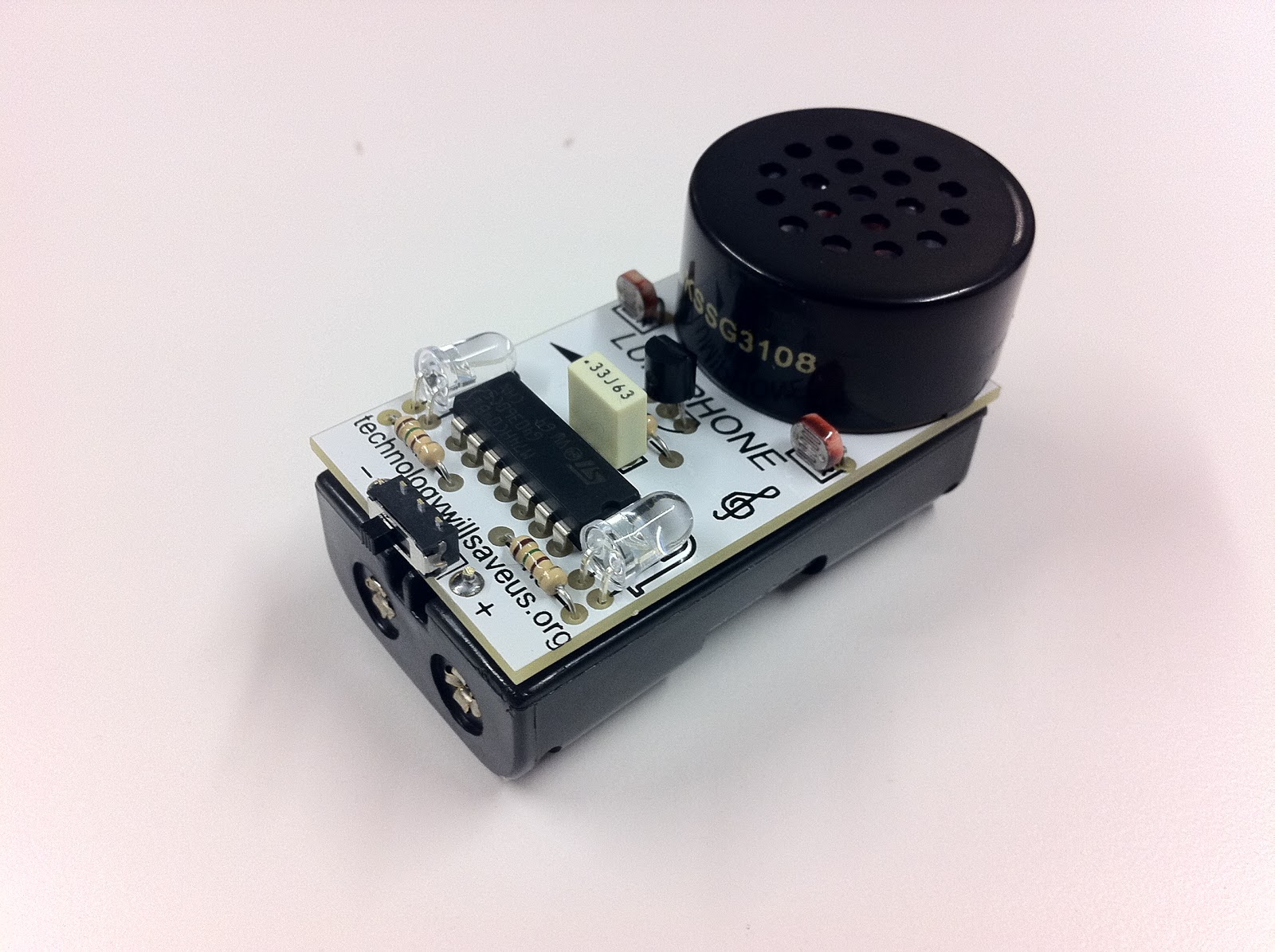
They also sell little kits, like this Lumiphone, which I bought of them for £10. It comes with all the parts, all you have to do is solder them together.

It works like a Theremin, those odd sounding instruments you hear in films like Forbidden Planet. There are two LED's shining onto light sensors; the one on the left controls the volume of the noise, the one on the right controls the pitch. All you do is vary how much you stick your fingers in between them and it makes funky noises.

What amazed me was how simple the circuit was. Apart from the 2 resistors to protect the LEDs, it only uses 6 types of components to make the noise: a capacitor, a transistor, a resistor, 2 LDR's, 2 inverters (the IC) and of course the loudspeaker.

It was easy to make and its fun to play with; a classroom-worthy project.

Check out a video of it working below.